RESET
Museum. Collection. Future.
On the occasion of its 35th anniversary, Museum Haus Konstruktiv is hosting a spectacular collection exhibition. Under the title RESET, selected new additions are presented, together with outstanding collection pieces that have not been shown for some time. In the Spotlight section, these chosen artworks are supplemented by four relatively young Swiss artists’ newly produced works. On the basis of their positions, we demonstrate the direction in which our collection could be extended in the future.
The drive to keep addressing the in-house collection in depth, enhancing and shedding light on its various facets, is always present in the museum’s work, but has been further intensified by the pandemic. In the title RESET, we make reference to a concept from electronics, which describes returning a system to its defined initial state. With such a process in mind, we reflect on our core tasks in this show: collection, conservation and mediation of constructivist-concrete and conceptual art. Where did our collection begin? How does it come across at the moment? Where is it heading? And how is it linked to current issues and topics?
The result is an exhibition that encompasses painting, sculpture, installation and video, while also generating new conceptual spaces by drawing astonishing connecting lines: from the most recent acquisitions and donations, to older collection pieces by artists in the Zurich Concretists’ broader milieu. With numerous solid publications, we have already made it clear that we see ourselves as not just an experiential museum, but primarily as a competence center for critical incorporation of constructivist-concrete and conceptual art, with one of our main goals being to impart knowledge about such art. We also meet this aspiration with in-depth texts on the artists represented in our collection and in the exhibition.

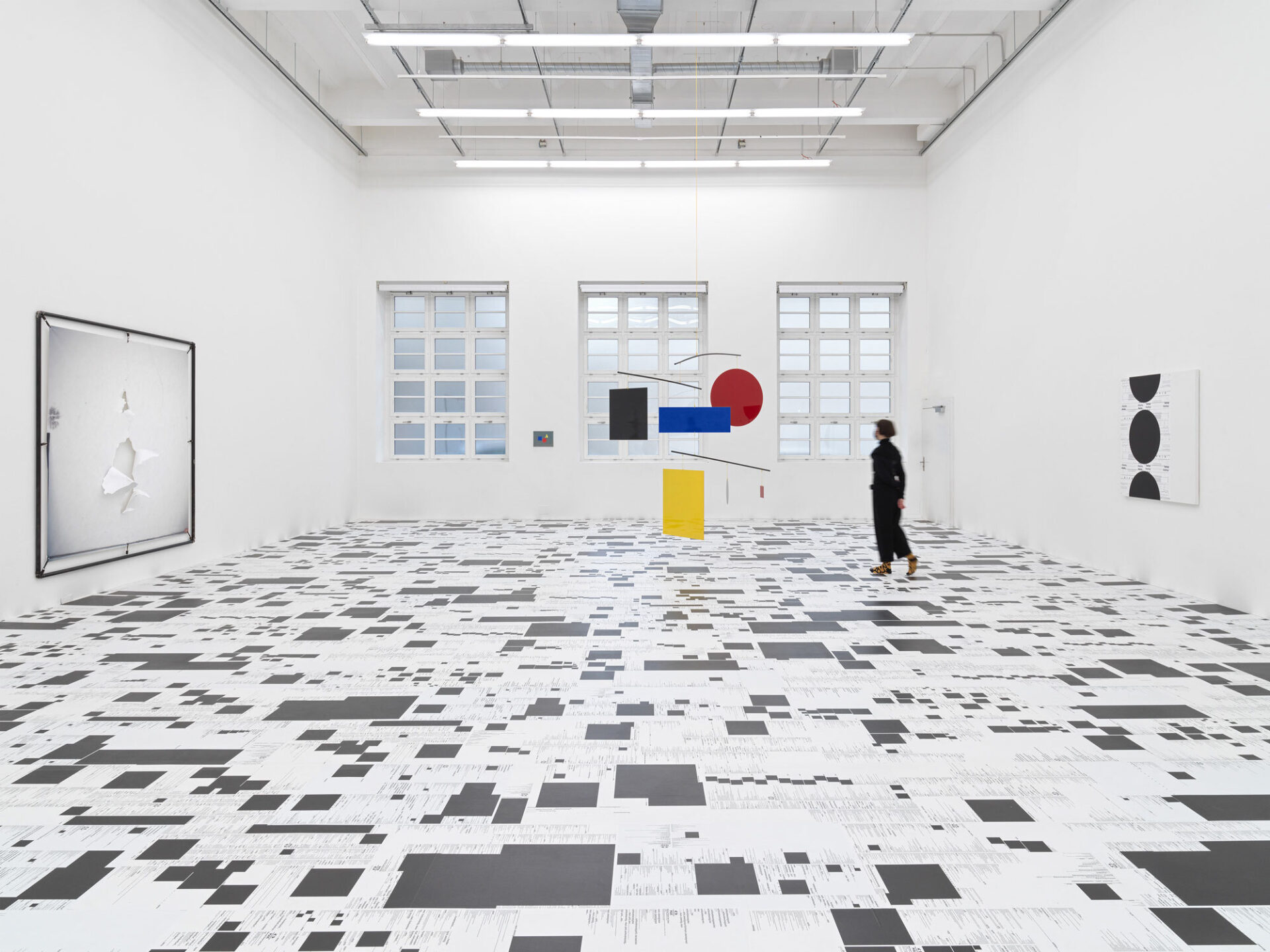
The exhibition begins with the large-scale walk-through floor piece Ohne Titel (fünf eins sechs sieben neun elf zwei), produced in 2014 by German conceptual artist Michael Riedel (b. 1972). This comprises a set of 14 posters, which have been reproduced so many times that they cover all the flooring on the first floor with a pattern of text fragments and blackened rectangular fields on a white background. The printed text is a transcript of conversations held in 2003 in the Vienna Secession while an exhibition was being installed there: Riedel was realizing a replica of his art space “Oskar-von-Miller-Straße 16”. Readable in principle as a guide to reconstruction of that space’s rooms, the transcript was edited for the posters in such a way that legibility takes a back seat as a criterion and text comes to the fore, as the material of Riedel’s art production.
The works by German artist Manfred Mohr (b. 1938), one of the pioneers of digital art, also present themselves exclusively in black and white. Since the late 1960s, Mohr has been developing algorithm-based plotter drawings, in which he systematically explores two-dimensional representation of cubes, which he extends into the sixth dimension. The cluster of lines in the computer-generated painting P. 453 AH/8 (1990), newly added to the collection two years ago, comes from a five-dimensional hypercube. Czech painter Zdeněk Sýkora (1920–2011) also devoted himself to computer art. Sýkora’s work with the computer, unlike Mohr’s, gave rise to seemingly free line paintings, in which line thickness, line route and coloring were determined by a limited randomization program. On the opposite side of the exhibition hall are two large-format paintings by Cristina Spoerri (1929–2013), showing geometric and lyrical elements in a dynamic balancing act.

The imposing Mondrian Mobile (2018) by Thomas Moor (b. 1988) and the small-format painting Bauhaus Porn (2020) by Francisco Sierra (b. 1977) are among the latest additions to the museum’s collection. Moor’s mobile makes reference to an item sold in the Guggenheim Museum’s store, designed by Greenberg & Kingsley in 1996. To counter accusations of plagiarism from the Alexander Calder Foundation, the designers enriched their original design with elementary geometric forms in red, yellow, blue, white and black, reminiscent of the neoplasticist compositions by Dutch painter Piet Mondrian. Fascinated by the story of this crude recreation, Moor produced a large-format art object in 5:1 scale – an original, to which the decorative product (which incidentally is also available in our museum shop) can now ‘belatedly’ refer. Francisco Sierra also alludes to 1920s art in his piece. With minimal interventions, he transfers a triangle, square and circle to a figurative and almost x-rated scene, a cynical comment on the popularity of the Bauhaus era.
The installation by Cassidy Toner (b. 1992) is called A Wall from the Atelier. The large-format photoprint on Tyvek paper shows a wall from Toner’s studio. It seems to give the observer a glimpse into the artist’s private studio – down to the finest wires in front of the wall and the nails stuck into it. However, the deep tear in the paper destroys the illusion of an intimate relationship between artist, artwork and observer. References to Lucio Fontana’s slashed canvases and Ad Reinhardt’s 1946 cartoon How to Look at a Cubist Painting
resonate in equal measure.

The exhibition space on the second floor is all about the relationship between constructivist-concrete and dadaist art. The example of Sophie Taeuber-Arp (1889–1943) shows how connected these two art movements can be, despite art history mostly construing them as complete opposites. She made a name for herself in the 1910s and 1920s with appearances in the circle of the Zurich dadaists. At the same time, she created paintings and textile works with abstract geometric compositions. The reconstruction of her Bar Aubette (created in collaboration with Hans Arp and Theo van Doesburg between 1926 and 1928 in Strasbourg but destroyed in 1938) is one of the highlights of our collection. For the walls and ceiling, Taeuber-Arp chose a composition comprising a multitude of monochrome rectangular surfaces in various finely coordinated color tones.
Along with Fritz Glarner’s Rockefeller Dining Room (1963/64), which is on permanent display on the fifth floor of our museum, Bar Aubette is one of the most important constructivist interior designs, in which painting and architecture combine to form an art-cum-living space.
In this exhibition, the works Immprrecision Optics and Dada Kopf by Sadie Murdoch (b. 1965) play a similarly mediating role between constructivist and dadaist tendencies. For her color photographs in black, white and shades of gray, this British artist uses archived visual material (here from Bar Aubette and Taeuber-Arp’s famous 1920 portrait photograph with Dada Kopf) and fuses them with fragments of her own body to create scenes that are as well-composed as they are enigmatic. The other exhibits in this room are also situated in the field of tension between stringency and play, and between reality and fiction. While the exhibited works by Romy Weber (b. 1936) and Ulla von Brandenburg (b. 1974) are more in the tradition of dada, the paintings by Willy Müller-Brittnau (1938–2003), Jakob Bill (b. 1942) and, in a broader sense, Clare Goodwin (b. 1973) show strong links to constructivist-concrete art.


The attention of anyone entering the columned hall is first caught by the works of Daniel Göttin (b. 1959) and Rita Ernst (b. 1956). Both these artists address issues involving architecture and the space. Göttin’s installation Multiple Display 2 comprises nine strips of multiplex board, painted with various stripe formations in bold red, black and white, and leaning against the wall at regular intervals. The gaps between them are integrated into the work and, in turn, the work becomes part of the space. The paintings Cristallina III and Cristallina IV by Rita Ernst are based on floor plans of historical castelli. Via rhythmic distribution of vertical and horizontal fields and strips, in black, gray, silver and white, this artist creates image spaces that are enlivened by fascinating play with the relationship between figure and ground. An orthogonal linear structure also organizes the picture surface in the 1996 piece Mieder by Beat Zoderer (b. 1955). However, unlike Ernst’s work, this structure is not painted, but made of various beige and brown garters, which are loosely plaited and stretched around the canvas.
Markus Weggenmann (b. 1953) combines geometric abstraction with implied representation in his conceptual paintings. His work always has various investigations into color at its core, be it in his early hand-painted stripe paintings, such as Untitled (6/20/1994), or in his aluminum paintings sprayed with car paint, such as Kraut (No. 230), which are characterized by an amorphous vocabulary of forms.
Other works in the columned hall and in the left-hand cabinet, by Marina Apollonio (b. 1940), Arturo Di Maria (b. 1940), Ulrich Elsener (b. 1943), Arend Fuhrmann (1918–1984), Hans Jörg Glattfelder (b. 1939), Marguerite Hersberger (b. 1943), Hans Hinterreiter (1902–1989), Marcello Morandini (b. 1940), Peter Somm (b. 1940), Renato Spagnoli (1928–2019), Anton Stankowski (1906–1998), Jürg Stäuble (b. 1948), Peter Struycken (b. 1939), Gido Wiederkehr (b. 1941) and Shizuko Yoshikawa (1934–2019), are very broadly based on the geometric design principles established by first-generation representatives of constructivist-concrete art and developed further in manifold ways by subsequent generations.

Minimal art and conceptual art, both initiated in the 1960s and still very current today, tie in with central principles of concrete art, such as the stripped-down language of forms, the strong focus on the (image) surface, the postulate of objectivity and the annulment of the artistic subject. The works by Andreas Brandt (1935–2016), Jan van Munster (b. 1939), Nelly Rudin (1928–2013) and Natalia Stachon (b. 1976) presented in the columned hall’s right-hand cabinet are closely related to such approaches. The same applies to the pieces by Heidi Künzler (1943–2019) and Carsten Nicolai (b. 1965) in the smaller exhibition space opposite the columned hall. Most of Künzler’s works comprise multiple parts, are designed using simple forms and draw attention to spatial relations. This is also true of the six blue acrylic-glass panels, as well as the spatial intervention consisting of two beams in black and green lying on top of each other. Both pieces are part of a body of work from the artist’s estate, donated to Museum Haus Konstruktiv last year.
Carsten Nicolai, best known for his sound and light installations, addresses scientific phenomena in his oeuvre, as well as the visualization of hidden systems of order. Perfect Square visualizes a mathematical principle by means of layered mirrored glass surfaces: A ‘simple perfect squared square’ is one made up entirely of unequally sized individual squares. The fact that this requires at least 21 individual squares was mathematically proven in 1978. In addition to Künzler and Nicolai, we present pieces by Olivier Mosset (b. 1944), Sylvie Fleury (b. 1961) and Beat Huber (b. 1956). Implemented in different ways, these draw on visual aesthetics from the 1960s (hard edge) and 1980s (neo-geo), as well as on symbols and motifs from popular culture (advertising and signage). Related approaches are evident in the 2011 video piece Hard Edge Ride by Dominik Stauch (b. 1962) in the stairwell, as well as in the murals (Easy Heavy III and Eye to Eye 2013) by Claudia Comte (b. 1983) in the museum café.
A different situation can be encountered in the rooms on the fifth floor: Here, the focus is on four relatively young artists, who were given free rein to occupy one room each, in the Spotlight section of the collection exhibition.

In the very first exhibition space, Guillaume Pilet (b. 1984) captivates the observer with an immersive presentation: a mural, a curved panoramic image, three pedestallike objects in garish raspberry red, lemon yellow and sky blue, and a video piece. The initial impression, that the artist is out to sensorially entice or even overwhelm the observer with iridescent colors and patterns, is only one approach to this multifaceted spatial situation. On closer inspection, it becomes clear that for his conceptual design, Pilet extensively studied systems of order in 20th century art and architecture. The height of the canvas’s upper edge, for example, at 226 cm, corresponds to the total height of a man 183 cm tall with an arm stretching upwards. This average value was key to the system of proportions developed by Le Corbusier between 1942 and 1955, the so-called Modulor, which constituted an attempt to give architecture mathematical order, oriented towards human measurements. The human body plays an important role in Pilet’s presentation in general. The panoramic image, for instance, was realized during a multi-day performance by a man to whom body paint had been applied. In turn, the pattern on the man’s skin resembled the one in the mural and, in a way, brings the mural to life. Moreover, the combination of color, pattern, and body in motion is also seen in Pilet’s enchantingly poetic video piece, which shows a chameleon, whose skin adapts to the changing colors of its surroundings. This sensorially sensitive approach to art, even to geometric abstract art, which can also be experienced through the video, is of importance to this artist, who studied under John Armleder and Philippe Decrauzat, among others, at ECAL in Lausanne. In the run-up to his presentation at Museum Haus Konstruktiv, Pilet wrote a ‘palimpseste’ about the manifesto (and ‘basis’) of concrete art, which was co-authored by Theo van Doesburg in 1930. Passages were deleted from the original text, leaving only words that correspond to Pilet’s notion of abstract geometric art, including: “L’art est universel” and “L’œuvre d’art doit être entièrement conçue et formée par l’esprit, la nature, la sensualité, la sentimentalité.”


The spatial intervention by Sam Porritt (b. 1979) comes across as almost meditative. This artist has positioned a total of eight objects in such a way that they suggest a space within a space. The corner pieces with wavy edges are made of styrofoam, covered with pasted-on canvas and painted with a mixture of marble dust, sand, binder and pigment in natural tones. This coating brings to mind the washed-out plaster of Italian palazzi and gives the elements a quasi-historical appearance. At the same time, the objects can also be seen as related to works by Robert Morris or Sol LeWitt, representatives of minimal art in the 1960s, who addressed the corner of the space as an architectural structure. In the title Untitled (Where Dust Gathers), references to the history of both art and architecture resonate: Untitled emphasizes the sobriety of self-referentiality, while the note in parentheses Where Dust Gathers highlights the poetics of the naturally aged.
The wavy line is a recurring motif in Sam Porritt’s artwork, seen both in his representational and non-representational visual compositions on paper, and he has been transferring it to the three-dimensional space for several years now. Here in this room, in accordance with its function in technical drawing, it also becomes a symbol of the wall, floor and ceiling elements to be imagined – or, as Porritt puts it, the “visual equivalent of an etc. or blah blah blah.”
Architecture is also an important source of inspiration for Alexander Bühler (b. 1977). Impressions of Mexico City’s everyday cityscape are incorporated into his presentation at Museum Haus Konstruktiv: a bird’s-eye view of the geometric historical city layout, colorful facade paintings and billboards flanking the dilapidated highways. Bühler, who studied at Chelsea College of Art and Design and now alternates between living in Mexico City and Zurich, has been intuitively translating such impressions into an abstract geometric language of forms since 2014. Initial sketches serve as templates for his larger wooden panels. Their strong grain emphasizes the materiality of the image carrier, which is an essential element of the composition. Strips of untreated wood, masked with tape before the application of paint, create the internal structure of individual panels. In some places, wherever the torn edge of the adhesive tape has left traces, noticeable irregularities spontaneously appear. Bühler realizes the color fields by applying one or more layers of acrylic with a brush, thus also highlighting the properties of this material.
A total of eight such brightly colored panels are joined together in the exhibition space to form a kind of billboard, fitted crosswise into the room and dividing it in two. Another panel hides behind it, now here as a painting. With the title Billboard Nostalgia, Bühler is referring to memories of car trips through his second homeland: “In Mexico, many of these billboards on the highways are empty, devoid of any content. Wind, sun and rain leave behind abstract imagery, rudiments of past messages. They evoke a past momentum and contain their own kind of poetry.”

Eins nach dem andern is the title of the sophisticated installation set up by Ana Strika (b. 1981). Unlike her earlier works, which are primarily defined via the space, her latest piece at Museum Haus Konstruktiv is characterized by a focus on the walls, while the interior of the space, the actual stage, remains empty. As the title suggests, the artist has placed a multitude of objects along the walls, one after the other, with utmost precision. They comprise delicate branches, pieces of cardboard, scraps of paper, wooden blocks, ropes, wire mesh, pieces of fabric, molded Plasticine, Fimo, modeling clay and plaster. These so-called ‘props’ come from the artist’s personal pool of items, which she uses like a construction kit, whose components she disassembles, conducts material experiments on, and combines with other substances. Presented in new site-specific constellations, each object, no matter how small, invites the observer to embark on a mental journey and to allow associations to arise, which, however, also keep threatening to slip away. Strika speaks of an “intermediate state of the unfinished” in this context. “I like it when the objects remain in a fleeting state,” she says. “[...] The sometimes unbearable limbo between possibilities before the making of a decision, which always entails a multitude of exclusions. Our thoughts are consistently ‘coming into being’, whereby the only constant is change.”
With artworks by Marina Apollonio, Jakob Bill, Ulla von Brandenburg, Andreas Brandt, Claudia Comte, Arturo Di Maria, Ulrich Elsener, Rita Ernst, Sylvie Fleury, Arend Fuhrmann, Fritz Glarner, Hans Jörg Glattfelder, Daniel Göttin, Clare Goodwin, Marguerite Hersberger, Hans Hinterreiter, Beat Huber, Heidi Künzler, Manfred Mohr, Thomas Moor, Marcello Morandini, Olivier Mosset, Willy Müller-Brittnau, Jan van Munster, Sadie Murdoch, Carsten Nicolai, Michael Riedel, Nelly Rudin, Francisco Sierra, Nedko Solakov, Peter Somm, Renato Spagnoli, Cristina Spoerri, Natalia Stachon, Anton Stankowski, Jürg Stäuble, Dominik Stauch, Peter Struycken, Zdeněk Sýkora, Sophie Taeuber-Arp, Cassidy Toner, Romy Weber, Markus Weggenmann, Gido Wiederkehr, Shizuko Yoshikawa, Beat Zoderer
In the Spotlight section invited artists: Alexander Bühler, Guillaume Pilet, Sam Porritt, Ana Strika